I started this week writing a very different article to the one I am now. This is not a politics blog, but on Friday morning it became clear that something momentous had happened and to write about anything else would now be trivial.
This week my country was asked “should the United Kingdom remain a member of the European Union or leave the European Union?” 17,410,742 people voted to leave. 16,141,241 voted to remain.
I voted to remain.
Whilst there are things about the EU that I don’t like, politics must inevitably involve compromise. On balance I saw Britain’s membership as a good thing and voting to remain a straightforward and rational decision.
I believed our economy would be stronger as a member.
I believed our voice in the world would be more influential as a member.
I believed that the ease of traveling, studying, working and living in 27 other member states was a huge benefit.
I believed that leaving would not help the UK to be a more modern and outward-looking country.
As it is, I can’t see any evidence yet to suggest that the above factors will improve now that we are leaving.
I’m angry, but I want to be proven wrong. I really do.
Unlike an election, this is not a decision that can be reversed in five years. The permanence of this vote was summed up by my former colleagues at M&C Saatchi.

So far the fallout has seen France overtake the UK as the world’s fifth largest economy and the pound at its weakest for 31 years. At this stage we can only speculate what effect the move will have on overall employment. In London’s financial services sector alone, some are predicting job losses of up to 70,000 over the next 12 months.
Why care about the City? Aside from employing many people both directly and indirectly, it generates huge quantities of tax – £66.5bn in the 2014/15 financial year, equivalent to 11 per cent of all government tax receipts. This is more than central government spending on eduction, defence, welfare, policing, prisons, or transport.
The weekly £350m of extra funding for the NHS pledged by the Vote Leave campaign suddenly doesn’t look so great when accompanied by a huge reduction in tax revenue.
Politically, we are losing an able Prime Minister in David Cameron, and at the time of writing over a third of the shadow cabinet had quit in an attempt to oust Leader of the Opposition, Jeremy Corbyn.
However, worse than the turbulence caused by our new political and economic realities, we have seen the emergence of huge divisions in our society. One of the most interesting explantations of the sociology of the vote, which I strongly recommend reading, can be found here.
A lot has been made of the age split in voting. The youngest voters, who will experience the consequences of Brexit for longest of the electorate, strongly voted to remain.
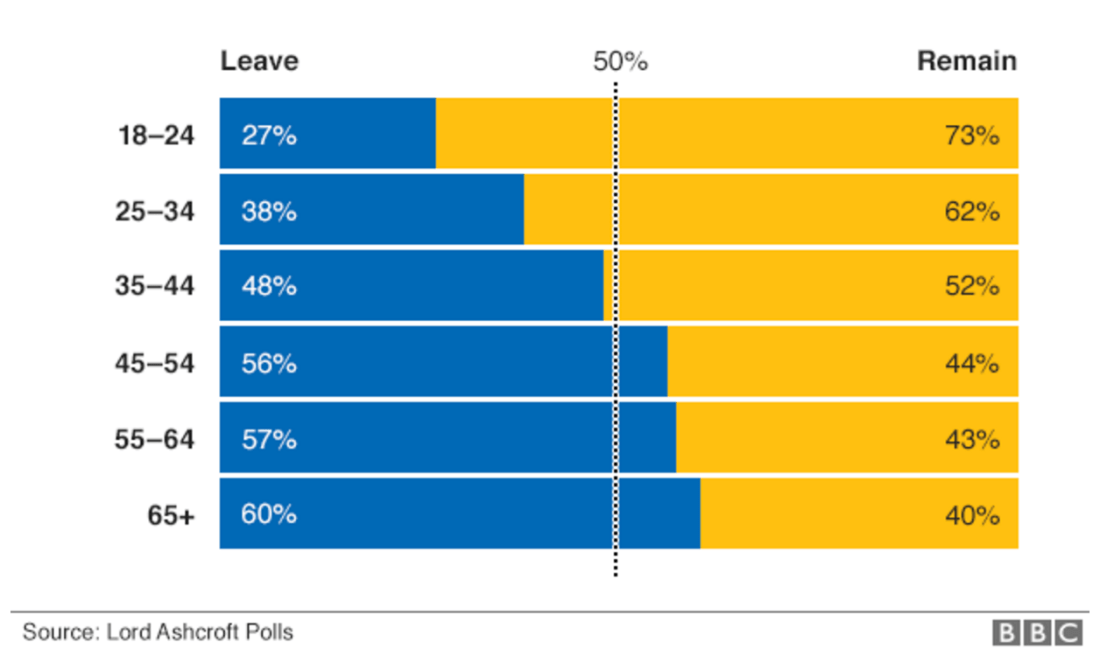
Whilst there is no clearcut clearcut data on turnout by age, there was a very strong correlation between median age in an area and the percentage of people who voted. The uncomfortable truth for my generation is that old people decide votes, not because of some unfair advantage or grey conspiracy, but because they turn up. For all the thousands of Facebook posts, retweets, protest attendees or petition signatures that young people generate, elections and referenda are ultimately decided by people putting an ‘X’ on ballot papers.
Expressing your views is fine (I am right now), but if you don’t register and vote it doesn’t count for much in the end.
Fragmentation can also be seen in the contrasting ‘leave’ majorities in England and Wales and ‘remain’ majorities in Scotland and Northern Ireland. Nicola Sturgeon, First Minister of Scotland was one of the quickest to respond, calling for a new independence referendum on Friday morning. Leaving the European Union, founded in 1993, is one thing. The break up of the Union with Scotland, created in 1707, is something altogether different.
There is also much soul searching to be done on the gulf that has emerged between the supposed elite and the “real, ordinary, decent people” referred to by Nigel Farage in his victory speech.
The vote was a proxy for many questions – the future, the European project, sovereignty, globalisation, national pride, the country’s leadership, austerity, immigration – some more legitimate than others, but all counting towards the same end result. Vote Leave’s slogan ‘take back control’ was vague – what control? From who? But it clearly covered enough of these issues to resonate with a large chunk people who felt that they were not in control.
There was an awful lot of nastiness during the campaign, the UKIP ‘Breaking Point’ poster constituting a particular low. No side in the referendum had a monopoly on right ideas or good conduct, but since the result there has been a worrying surge in xenophobia on our streets, exemplified by the news today that racist graffiti was daubed on a Polish community centre in Hammersmith. It may well be that the perpetrators did not vote on any side in the referendum, but the current climate has raised tensions and emboldened acts of thuggery.
At the same time we have seen an MP, David Lammy say that the referendum was non-binding and should be rejected by Parliament. This response is insulting to 17m leave voters and shows how people might justifiably feel they are ignored. You may think the referendum should never have been held and be angry at the result, but to obstruct it now would not be democratic.
The fact is, however much I and others may wish to, we can no longer go back to the comparative certainty of the pre-vote UK. The genie is out of the bottle. There will be anger and disappointment, but the UK badly needs solutions and not just endless recriminations on both sides of the argument. Shouting louder than the other guy will not heal the rifts in our society or strengthen the UK. We would do well to get better at listening to each other instead.
What happens next will shape the destiny of the UK for years to come. A lot of it won’t be pretty, but in the current vacuum we also need people with a positive vision of how we can unite people, move forwards and find our new place in both Europe and the rest world.

 Henry Yorke