#6 Charmaine Leung – Growing Up in a Red Light District

For this episode I spoke to Charmaine Leung author of 17A Keong Saik Road: A Personal Story.

Her memoir recalls a childhood in 1970s Chinatown when it was a prominent red light district in Singapore, and takes its name from the address of the brothel that her mother used to run. 

The book starts with Charmaine’s mother coming to Singapore as a young child after being sold by her birth parents, and weaves together an intimate family portrait with the broader history of Keong Saik’s transformation from the 1930s up to the present day.

I learnt about a lesser-known part of Singapore’s history, traditional customs and even some of the requirements of running a brothel successfully. But what shines through most of all is the resilience of the women whose lives are chronicled, as they persevered through immense challenges towards a better future.

You can also find this episode on iTunesSpotify and anywhere else you get your podcasts.

Show notes

  • Introduction to Chinatown’s history (01:45)
  • Awareness of Chinatown’s status as a red light district growing up (05:40)
  • Adults’ shame about living in Chinatown (07:49)
  • Interaction with working women as a child (10:01)
  • Using makeup as a form of armour (12:38)
  • Uncovering her mother’s life story (14:06)
  • Taking inspiration from her mother (15:49)
  • Moving out of the red light district (17:40)
  • Charmaine’s writing process (19:14)
  • Trigger for starting work on the memoir (20:46)
  • The hardest part of writing 17A Keong Saik Road (23:16)
  • Mother’s reaction to the book (25:57)
  • Charmaine’s feelings when she goes back to Keong Saik today (31:51)
  • Literary inspiration for the writing (33:35)
  • Advice Charmaine would you give to her younger self  (35:17)
  • Writing projects in the pipeline (37:15)
  • Quick fire questions on Singapore (39:35)
  • Which creative person or group would you like to shine a spotlight on? (43:30)
  • Who would you like to say thank you to and why? (44:40)

Links

17a Keong Saik Road Website

Ethos Books

Straits Times Interview

Wild Swans

Memoirs of a Geisha

Ya Hua Bak Tuh Teh

Getting In Touch

Join the Red Dot Voices group on Facebook: https://www.facebook.com/RedDotVoices/

Disclaimer

Unless otherwise stated, I do not receive any payment or gifts in kind for endorsement. I also promise never to try and sell you Fit Tea.

#5 Bjorn Low – Making A Greener Little Red Dot

For this episode I spoke to Bjorn Low founder of Edible Garden City.

Bjorn grew up in Singapore but only really got into gardening after living in the UK, where quit a successful career in advertising to study agriculture and volunteer on farms around the country.

After returning to Singapore in 2012 he soon realised that his dream of owning a farm had a very big problem – buying farmland in one of the smallest countries in the world costs millions of dollars. So he got creative, and Edible Garden City was born.

The social enterprise started off with a nomadic existence, teaching and growing on a carpark roof in Chinatown, a shop house in Little India and partnering with restaurants, hotels, schools and residences around the island. Since then, Edible Garden City has moved to a permanent location, was recognised at the 2019 Sustainable Business Awards, and will be showcased at the Dubai Expo 2020. Bjorn has also been named a finalist for the Straits Times Singaporean of the Year.

Our conversation touched on biodynamic agriculture, the challenges of bringing urban farming to Singapore, applying lessons from nature to running a business, the therapeutic qualities of gardening, and how Singapore can move towards greater food security in a post-COVID world. Bjorn’s tips on growing plants at home even inspired me to try growing from seed again, and I now have a baby tomato plant sitting on the windowsill beside me.

You can also find this episode on iTunes, Spotify, Overcast and anywhere else you get your podcasts.

Show Notes

  • How Bjorn got into gardening and farming (01:52)
  • Learning about biodynamic agriculture (06:06)
  • Returning to Singapore and challenges starting out (13:26)
  • Opportunities from trends in F&B (15:36)
  • Creating a community of people around Edible Garden City (17:26)
  • Settling in Jalan Penjara (22:31)
  • Creating a sustainable model (24:41)
  • Applying lessons from nature to business (26:40)
  • How to keep going and avoiding burnout (29:35)
  • Gardening as a healing process (30:26)
  • Tips for gardening at home (31:51)
  • Eating your own produce (36:59)
  • Role of urban farming in a post-COVID world (38:32)
  • Challenges for Singapore’s food security (41:35)
  • Bjorn’s advice to his younger self (44:46)
  • Projects outside of Singapore (46:20)
  • How urban farming will evolve in the next 5 years (47:52)
  • Quick fire questions on Singapore (52:09)
  • Which creative person would you like to shine a spotlight on (55:55)
  • Who would you like to say thank you to and why? (56:43)

Links

Getting In Touch

Join the Red Dot Voices group on Facebook: https://www.facebook.com/RedDotVoices/

Disclaimer

Unless otherwise stated, I do not receive any payment or gifts in kind for endorsement. I also promise never to try and sell you Fit Tea.

#4 Ang Jolie Mei – The Life Celebrant

For this episode of Red Dot Voices, I spoke to Ang Jolie Mei.

Her father was one of the pioneers of Singapore’s funeral industry, and after he passed away when Ang Jolie was just 24, she joined her mother in taking over the family business.

Having taken time out to work in finance, Ang Jolie returned to the funeral industry and set up The Life Celebrant in 2010. She had travelled widely to study different funeral practices, and was motivated by a desire to provide a more holistic service to families of the deceased.

As one of very few women funeral directors in Singapore she has a fascinating perspective, and in 2017 she shared her experiences in the memoir, Dying To Meeting You: Confessions of a Funeral Director. She subsequently won the ‘Most Innovative’ prize at the 2019 Women Entrepreneur Awards.

Ang Jolie’s passion for living life with empathy, without regrets, and celebrating it fully, is a very valuable message – now more than ever. I came away from our conversation uplifted and inspired, and I hope that you will too.

You can also find this episode on iTunes, Spotify, Overcast and anywhere else you get your podcasts.

Show Notes

  • Memories and influence of Ang Jolie’s father (1:58)
  • Stigma towards families in the funeral profession growing up (5:32)
  • Motivation to work in Finance (7:31)
  • Return to the funeral industry (10:03)
  • A woman in a man’s world (12:24)
  • Supporting bereaved people, processing grief and avoiding burnout (15:49)
  • Bringing funeral practices from other countries to Singapore (19:22)
  • Process of writing a eulogy for the deceased (30:57)
  • Is it easier or harder to organise a funeral for someone you’ve met (34:43)
  • The most challenging funeral Ang Jolie has organised (35:50)
  • Personalising funerals to celebrate life (38:55)
  • Advice for people planning their own funerals (43:46)
  • Ang Jolie’s own funeral plans (46:35)
  • How working close to death has influenced Ang Jolie’s life philosophy (49:29)
  • Tips for self-care and maintaining balance (54:23)
  • Different types of meditation (57:14)
  • Quick fire questions on Singapore (59:54)
  • Which creative person would you like to shine a spotlight on? (1:02:45)
  • Who would you like to say thank you to and why? (1:05:25)

Links

Getting In Touch

Join the Red Dot Voices group on Facebook: https://www.facebook.com/RedDotVoices/

Disclaimer

Unless otherwise stated, I do not receive any payment or gifts in kind for endorsement. I also promise never to try and sell you Fit Tea.


#3 Alvin Yapp – Treasures of the Intan

For this episode of Red Dot Voices, I spoke to Alvin Yapp.

In 2003, Alvin founded The Intan. As well as being his home in Joo Chiat, The Intan is a museum which is open to the public and houses his collection of over 5,000 Peranakan antiques.

The Intan has featured internationally on CNN, The Washington Post and even the Singapore Airlines safety video.

I was lucky enough to visit for the first time two years ago, and it was a really fun introduction to an area of Singaporean history I knew very little about. Alvin is a born storyteller and an authority on Peranakan culture.

For this interview we discussed what Peranakan culture is, how he learnt about his heritage growing up, his extensive travels, and some of the extraordinary stories behind items in his collection.

You can also find this episode on iTunes, Spotify, Overcast and anywhere else you get your podcasts.

Show Notes

  • First experience of Peranakan theatre (01:28)
  • Learning about Peranakan culture growing up (03:15)
  • Defining Peranakan identity and culture (06:03)
  • Background on the Intan building (11:51)
  • Is enough being done to protect Peranakan culture (13:12)
  • How can people learn more about the culture (17:16)
  • When and where would Alvin go to with a time machine (19:34)
  • World War II impact on Peranakan community (21:17)
  • Childhood collecting (23:22)
  • Learning from travels (26:25)
  • Visit to Pakistan (30:14)
  • How Alvin learned to be a collector (34:43)
  • Stories attached to pieces in the collection (36:20)
  • Plans for expanding the collection (42:34)
  • Advice Alvin would you give to his younger self for collecting (44:08)
  • Single item to save from a fire (46:31)
  • Quick fire questions on Singapore (46:55)
  • Which creative person would you like to shine a spotlight on? (52:25)
  • Who would you like to say thank you to and why? (53:14)

Links

Getting In Touch

Join the Red Dot Voices group on Facebook

Disclaimer

Unless otherwise stated, I do not receive any payment or gifts in kind for endorsement. I also promise never to try and sell you Fit Tea.


#2 Calvin Soh – One Kind House and An Exponential Future

For the first interview of Red Dot Voices, I spoke to Calvin Soh.

Calvin’s background is in advertising and he’s previously been a creative leader at some of the best agencies in the world: Fallon, Publicis and R/GA.

While Calvin no longer works in the industry, as I found out, his creative journey is really just getting started.

As part of his mission to prepare his family for an exponential future, he set up One Kind House, an urban farm and cooking experience designed to recreate the kampong community spirit in 21st Century Singapore.

Our wide-ranging discussion also touched on the education systems of Singapore and Finland, the importance of building up a life skills CV, whether or not you can teach creativity and hustle, and why the ad industry is changing so much.

https://oembed.libsyn.com/embed?item_id=13169183

Show Notes

  • Brief on leaving advertising (1:40)
  • Influence of Mummy Soh (3:34)
  • Preparing his children for an exponential future (5:18)
  • Finnish and Singaporean education systems (7:54)
  • Living in Finland (12:15)
  • Importance of life skills CV (15:48)
  • Can you teach creativity and hustle? (19:54)
  • Technology and boredom (22:37)
  • Scaling creativity in education (23:55)
  • Pros and cons of universal basic income (26:48)
  • What skills from advertising does Calvin use now (31:14)
  • Why advertising industry is changing (33:33)
  • Current projects (38:35)
  • Opportunity of voice technology (40:38)
  • Changed ways of working in advertising (44:07)
  • Quick fire questions on Singapore (46:44)
  • Which creative person would you like to shine a spotlight on? (51:08)
  • Who would you like to say thank you to and why? (52:57)

Links

Getting In Touch

Join the Red Dot Voices group on Facebook: https://www.facebook.com/RedDotVoices/

Disclaimer

Unless otherwise stated, I do not receive any payment or gifts in kind for endorsement. I also promise never to try and sell you Fit Tea.

Japan

Not the most current content, but I visited Japan for the first time in January 2017, fell in love with place and made some videos of the trip.

Gratuitous? Perhaps – though I’d argue there’s an enduring appeal to Boss vending machines, Shinjuku neon, zen gardens, Fuji-san, and giant Yayoi Kusama pumpkins.

Enjoy Japan brought to you via shonky camerawork and iMovie editing!

Tokyo

Nara/Kyoto

Naoshima/Hakone

What Now?

I started this week writing a very different article to the one I am now. This is not a politics blog, but on Friday morning it became clear that something momentous had happened and to write about anything else would now be trivial.

This week my country was asked “should the United Kingdom remain a member of the European Union or leave the European Union?” 17,410,742 people voted to leave. 16,141,241 voted to remain.

I voted to remain.

Whilst there are things about the EU that I don’t like, politics must inevitably involve compromise. On balance I saw Britain’s membership as a good thing and voting to remain a straightforward and rational decision.

I believed our economy would be stronger as a member.

I believed our voice in the world would be more influential as a member.

I believed that the ease of traveling, studying, working and living in 27 other member states was a huge benefit.

I believed that leaving would not help the UK to be a more modern and outward-looking country.

As it is, I can’t see any evidence yet to suggest that the above factors will improve now that we are leaving.

I’m angry, but I want to be proven wrong. I really do.

Unlike an election, this is not a decision that can be reversed in five years. The permanence of this vote was summed up by my former colleagues at M&C Saatchi.
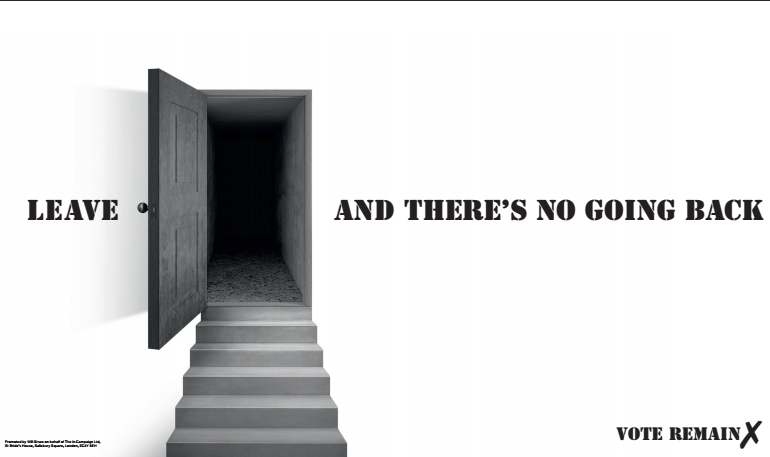
No Going Back

So far the fallout has seen France overtake the UK as the world’s fifth largest economy and the pound at its weakest for 31 years. At this stage we can only speculate what effect the move will have on overall employment. In London’s financial services sector alone, some are predicting job losses of up to 70,000 over the next 12 months.

Why care about the City? Aside from employing many people both directly and indirectly, it generates huge quantities of tax – £66.5bn in the 2014/15 financial year, equivalent to 11 per cent of all government tax receipts. This is more than central government spending on eduction, defence, welfare, policing, prisons, or transport.

The weekly £350m of extra funding for the NHS pledged by the Vote Leave campaign suddenly doesn’t look so great when accompanied by a huge reduction in tax revenue.

Politically, we are losing an able Prime Minister in David Cameron, and at the time of writing over a third of the shadow cabinet had quit in an attempt to oust Leader of the Opposition, Jeremy Corbyn.

However, worse than the turbulence caused by our new political and economic realities, we have seen the emergence of huge divisions in our society. One of the most interesting explantations of the sociology of the vote, which I strongly recommend reading, can be found here.

A lot has been made of the age split in voting. The youngest voters, who will experience the consequences of Brexit for longest of the electorate, strongly voted to remain.
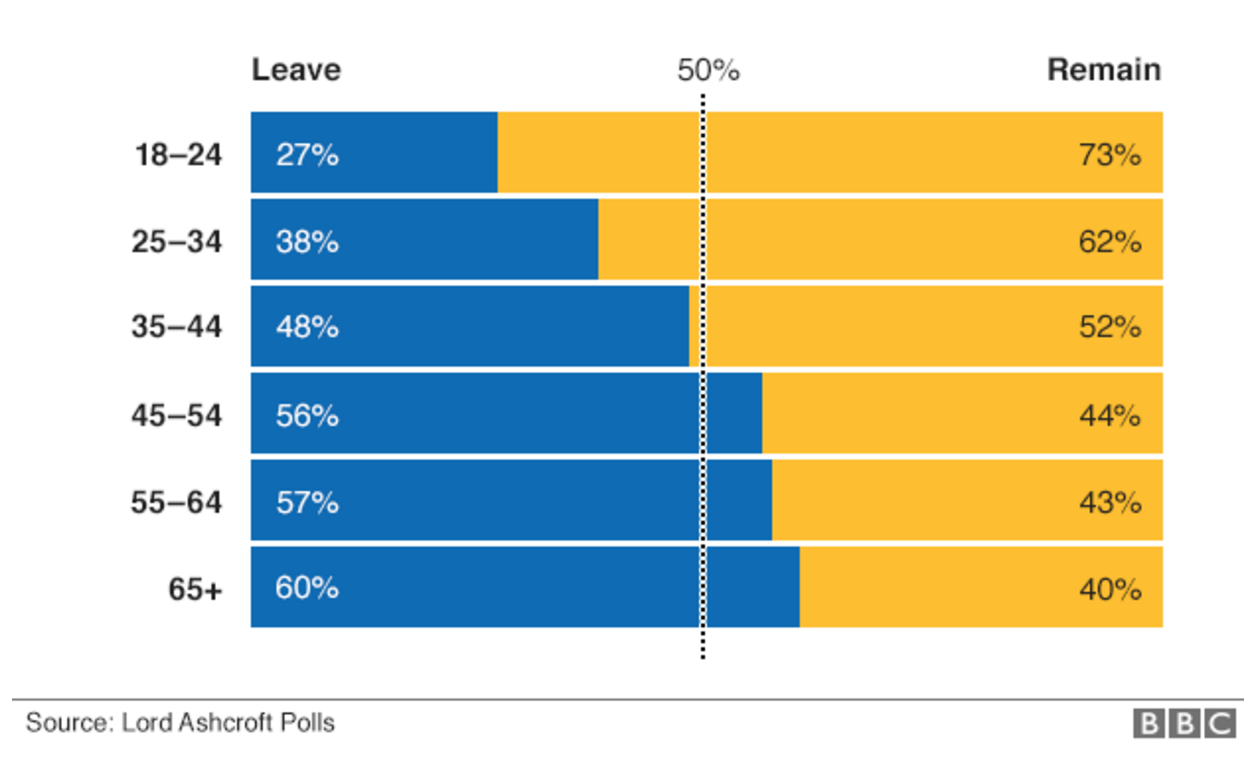
Screen Shot 2016-06-26 at 17.30.50

Whilst there is no clearcut clearcut data on turnout by age, there was a very strong correlation between median age in an area and the percentage of people who voted. The uncomfortable truth for my generation is that old people decide votes, not because of some unfair advantage or grey conspiracy, but because they turn up. For all the thousands of Facebook posts, retweets, protest attendees or petition signatures that young people generate, elections and referenda are ultimately decided by people putting an ‘X’ on ballot papers.

Expressing your views is fine (I am right now), but if you don’t register and vote it doesn’t count for much in the end.

Fragmentation can also be seen in the contrasting ‘leave’ majorities in England and Wales and ‘remain’ majorities in Scotland and Northern Ireland. Nicola Sturgeon, First Minister of Scotland was one of the quickest to respond, calling for a new independence referendum on Friday morning. Leaving the European Union, founded in 1993, is one thing. The break up of the Union with Scotland, created in 1707, is something altogether different.

There is also much soul searching to be done on the gulf that has emerged between the supposed elite and the “real, ordinary, decent people” referred to by Nigel Farage in his victory speech.

The vote was a proxy for many questions – the future, the European project, sovereignty, globalisation, national pride, the country’s leadership, austerity, immigration – some more legitimate than others, but all counting towards the same end result. Vote Leave’s slogan ‘take back control’ was vague – what control? From who? But it clearly covered enough of these issues to resonate with a large chunk people who felt that they were not in control.

There was an awful lot of nastiness during the campaign, the UKIP ‘Breaking Point’ poster constituting a particular low. No side in the referendum had a monopoly on right ideas or good conduct, but since the result there has been a worrying surge in xenophobia on our streets, exemplified by the news today that racist graffiti was daubed on a Polish community centre in Hammersmith. It may well be that the perpetrators did not vote on any side in the referendum, but the current climate has raised tensions and emboldened acts of thuggery.

At the same time we have seen an MP, David Lammy say that the referendum was non-binding and should be rejected by Parliament. This response is insulting to 17m leave voters and shows how people might justifiably feel they are ignored. You may think the referendum should never have been held and be angry at the result, but to obstruct it now would not be democratic. 

The fact is, however much I and others may wish to, we can no longer go back to the comparative certainty of the pre-vote UK. The genie is out of the bottle. There will be anger and disappointment, but the UK badly needs solutions and not just endless recriminations on both sides of the argument. Shouting louder than the other guy will not heal the rifts in our society or strengthen the UK. We would do well to get better at listening to each other instead.

What happens next will shape the destiny of the UK for years to come. A lot of it won’t be pretty, but in the current vacuum we also need people with a positive vision of how we can unite people, move forwards and find our new place in both Europe and the rest world.